


By Cindy Blackstock, CEO and Founder
Customer experience—say it and everyone’s ears perk up. CX is influencing and intersecting with consumer insights across most business sectors: CPG, Retail, Automotive, Financial and Healthcare, to name a few.
The X Factor
Despite it being a buzz worthy term, there doesn’t seem to be a singular, agreed-upon, industry-wide definition for the term customer experience, affectionately referred to as CX. Definitions and approaches to CX vary but most just want to know what that “X” factor means for categories, brand, and products.
Here at SIVO, we have our own perspective:
In truth, we have been working to reveal the customer experience all along. For us, it’s not an intimidating or nebulous concept, because we are quantitative and qualitative research experts who are skilled at understanding people to reveal their truths. Through the optimal combination of quantitative and qualitative research approaches, we get to the “what” by collecting customer experience data, identifying the touchpoints along the customer journey. Then, we get to the “why” behind the customer experience data—the stories, emotions, pain points and delights—and translate it into actionable ideas that businesses can use. The two research approaches go hand in hand with the discipline of CX.
Data + Stories = A Winning Formula
Many market research vendors try to capture the customer experience primarily through quantitative research techniques. Survey data is essential for quantifying the various paths and touchpoints along the customer journey. It plays an important role in validating the experience, so teams can also measure change over time. But the process can’t stop there. Survey data is necessary but is not a comprehensive measure of the customer’s voice.
SIVO believes clients need a better blend of data and stories to get the complete picture. It is the human component, in a truly “experiential” in-context setting, that brings the customer experience to life. To make a business impact, organizations need that qualitative, intimate understanding of the experience, to find out what is truly happening during each touch point. In other words, we believe that quantitative research helps identify what to improve, and qualitative research helps identify how to improve the customer experience.
The Steps to Insights
Your customers are on a journey. There may be many individual stops on the route that make up the overall experience. For example, access may be acceptable, customer service may be satisfying, but there may be positive and negative aspects of the product experience for the user. All these individual touchpoints may net to an acceptable customer experience but may not reveal the nuanced opportunity areas that could lead to an improved experience. Brand teams need to talk to customers and ask, “How are you doing?” instead of, “How are we (the company) doing?” These questions reveal the crucial and detailed human element of CX.
SIVO stiches together a map, an outline of the touchpoints that make up the journey of the entire customer experience. SIVO’s typical approach is 4 Steps:
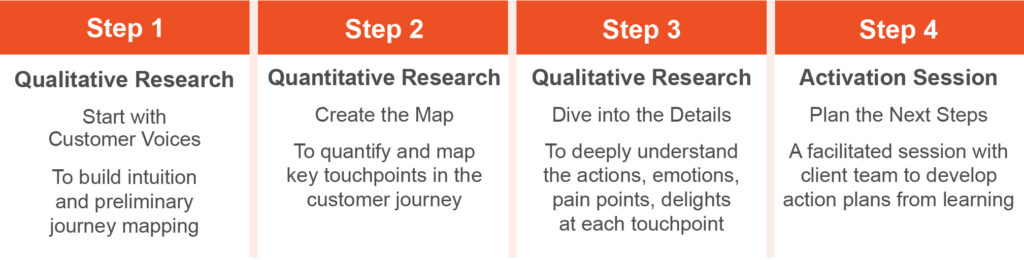
With preliminary insights that build team intuition, quantitative survey data to build and validate the journey, followed by qualitative deep dives to uncover the nuanced details, the true customer experience can be revealed. Teams can map customers’ interaction with the brand across each touchpoint, identify opportunity areas to act on and then track the customer experience annually, to ensure the quality of the experience remains positive or improves over time.
With the journey maps in hand, SIVO’s best practice is to facilitate an Activation Session so that client teams can immerse themselves in the journey and the voices of the customer. A few group discussions and exercises help teams to digest the learning, translate and prioritize into an action plan that can be shared with key stakeholders across the organization.
To discuss your customer experience research needs with experts from SIVO, please reach out to our team at Contact@SIVOInsights.com.
By Natasha Weith
Innovation is often seen as a creative pursuit—a way for businesses to stay ahead, differentiate, and drive growth. But for many companies, the innovation process feels uncertain. How do you know if an idea will resonate in the market? Will consumers adopt a new product, behavior, or service? How do you distinguish between a promising concept and a costly misstep?
Most innovation initiatives are guided by internal vision, expert intuition, and trend analysis—all valuable inputs. But in a rapidly shifting consumer landscape, these elements alone aren’t enough.
Too many innovations fail—not because they weren’t good ideas, but because they weren’t validated in the real world before launch. The key to success? Embedding consumer input via market research into every stage of innovation instead of treating it as a final checkpoint.
Companies often assume they “know” their market. Here’s where innovation efforts commonly go wrong:
The result? Companies invest millions in ideas that sound good internally but fail to gain traction.
Consumers don’t just react to new offerings—they make trade-offs based on convenience, price, and habit. A product might be superior on paper, but that doesn’t mean consumers will switch.
To succeed, businesses must:
Without these insights, even a groundbreaking innovation can flop.
The most successful companies don’t just test ideas—they build them alongside the target consumer using agile, iterative research. However, even companies that invest in research get it wrong when they:
✖︎ Use Research as a One-Time final checkpoint – Instead of a continuous input, insights are only used for last-minute validation.
✖︎ Seek Confirmation Instead of Challenge – Teams look for data to support their pre-existing beliefs instead of stress-testing their assumptions.
✖︎ Over-Rely on Stated Consumer Intent – What consumers say they’ll do and what they actually do aren’t always the same.
✖︎ Fail to Connect Insights to Execution – Research reports sit in PowerPoints instead of shaping strategy and launch plans in real-time.
That’s where agile market research comes in. And let’s be clear: Agile research isn’t just about speed – it’s about making sure insights are integrated into the development process and at every decision point. Here’s how:
By embedding agile insights, companies create faster, more successful go-to-market strategies—without unnecessary spend.
It’s easy to get excited about a breakthrough idea. But without rigorous, real-time consumer input, even the most promising innovations can fail.
The best companies don’t just test innovations—they co-develop them with their consumer target. They ensure research isn’t a last-minute formality but a continuous input that sharpens ideas and launch plans and accelerates success.
As you think about your next big move—whether launching a new product, repositioning a brand, or identifying a growth opportunity—ask yourself:
If you’re not fully confident in the answers, it’s time to rethink how market research fits into your innovation strategy.
At SIVO, we help businesses turn market research into a competitive advantage. Whether you're validating early-stage concepts, refining go-to-market strategies, or optimizing post-launch success, we ensure that insights fuel smarter, faster decision-making at every stage of the process.
Our senior insights professionals specialize in agile, in-context research that goes beyond validation to actively shape breakthrough innovations. And with On-Demand Talent, we provide fractional research experts to scale your capabilities—without long-term hiring commitments.
Want to sharpen your innovation strategy? Contact us at Contact@SIVOInsights.com or visit SIVOInsights.com to learn more.
As customer needs evolve and competition intensifies, traditional segmentation frameworks often fall short. Many segmentation models are based on demographics and psychographics, and often define customers based on traits such as their age, gender, attitudes and values. They tell you who your consumer is – but not why they make the choices they do.
To fuel meaningful, strategic growth, businesses need more than demographic snapshots. They need contextual insight. This is where frameworks like Demand Space thinking comes in.
Demand Space frameworks shift the focus from static consumer traits to the moments that drive decisions. Instead of defining your audience only by traits such as age, gender, or income, this approach considers:
It’s not about who your consumer is on paper – it’s about what’s happening around them, and inside them, when they make choices.
Consumers don’t always behave the same way, even when they share similar traits on paper. A single person has different needs and behaviors throughout the day, week, or year, and traditional segmentation often misses these moments that drive real-world decisions. Demand Spaces, on the other hand, are based on the moments where context, emotion, and need converge.
When implemented thoughtfully, Demand Spaces help businesses:
Demand Spaces help businesses find the moments when consumers are underserved by existing options. These blind spots often become the clearest opportunities for growth. By identifying emotional or contextual gaps in the consumer experience, teams can design solutions that respond to real pain points and not using assumptions.
They also help businesses go beyond what consumers say they want and uncover what they actually need in specific situations. This helps teams design offerings that better reflect real-world behaviors. It’s a way to spark smarter ideas, grounded in daily routines, shifting priorities, and overlooked occasions that traditional research often misses.
Demand Space tools help position brands based on context and need, not just category. This reduces overlap and creates clearer brand roles. That means brands can carve out distinct emotional territory, ensuring each one plays a defined role in the consumer’s life, not just on a shelf.
By focusing efforts on the most critical consumer moments – when the stakes, emotions, or needs are highest – teams can prioritize smarter. It enables brands to align resources with the occasions that drive the most value, loyalty, or conversion – improving both focus and ROI.
They also help in assigning each brand, product, or service distinct moments. This ensures they serve different needs or occasions rather than competing for the same ones. By separating who serves what – and when – demand spaces bring clarity to brand architecture and reduce inefficiencies across portfolios.
Demand Spaces help businesses unlock growth by bringing clarity to what consumers need, when they need it, and why. Instead of chasing broad segments or spreading resources thin, brands can focus on the moments that truly drive behavior – revealing new opportunities, reducing internal friction, and building solutions that resonate in the real world.
Let’s say your target is a 35-year-old parent who regularly shops for snacks. Depending on the situation, they might want:
Each moment carries different emotional and functional needs – and may lead them to choose entirely different brands or products. This is the nuance Demand Spaces capture.
In a challenging market, brands can’t afford to rely on guesswork. Demand Spaces provide both smarter lenses for targeting and innovation, a more human understanding of consumer behavior, and a faster path to discovering what will actually drive choice – and growth.
To identify and activate demand spaces, brands need to move beyond static surveys. Instead, they should use context-rich research tools like:
These are some of the methods that help businesses capture real consumer behavior, in real environments. At SIVO, we combine deep qualitative expertise with flexible research models to help you map the demand spaces that matter most to your business. Whether you're reassessing brand positioning, exploring whitespace for innovation, or trying to understand behavior shifts in today’s market – we help you with the right tools and insights for your business.
Want to talk about how Demand Space research can unlock strategic clarity for your team?
We’d love to help!
by Cindy Blackstock
Being part of a custom market research firm with global clients, we are often a go-to partner on international research—both qualitative and quantitative. And while all global market research has some challenges, global qualitative research has some unique ones.
From years of designing consumer research approaches, we’ve identified a list of questions we ask our clients to customize research for their needs. But whether you are researching with SIVO, another supplier, or leading research internally for your own organization; here are 5 watchouts when planning global, qualitative research. These apply for both in-person and virtual approaches.

Everything takes longer than domestic-only market research. Most global market research consists of multiple countries and languages. This requires added time to translate all materials such as recruitment screeners, discussion guides, and transcripts. For example, domestically you may receive a recruiting update every 1-2 days. But with the additional time needed to translate the recruiting progress, your updates may occur every 3 days with non-English speaking countries. And with transcripts needing translation time too, that delays the analysis and delivery of your final report.
SIVO Tip! When planning your research, build in extra time to account for translation needs on both the front and back ends of your research. This could easily add an additional 2-weeks to a simple qualitative design such as webcam focus groups.

Expect cultural differences in business norms. Corporate cultures differ around the world. When working with partners and consumers in other countries you need to expect, respect, and allow for cultural differences. One basic example of this is with interview start-times. As an example, our Thailand local moderator and consumers were consistently in-place and talking well before the official interview start time (making our client feel like they were late to observe the conversation); whereas in Brazil we had many consumers (and even a local moderator for one interview) who joined late.
SIVO tip! As a client who may be inviting other co-workers or organizational leaders to attend your research, prepare your team that some behaviors—from professionals and consumers—will be different. You can even remind your team these differences are likely one of the key reasons why you are conducting global research. Embrace it!

Know in advance if you want to adapt stimulus in real time. Particularly when researching marketing messages or communication, a client may learn from a few consumers and want to adapt the stimulus. This could be as simple as learning a word or phrase translated in your stim might be academically correct but needs to be modified to a more culturally relevant word – or it could be re-writing paragraphs of copy. In either example, you need a translator readily available to adjust the stimulus before the next interview.
SIVO Tip! Decide in advance if you will want or need to adjust your stimulus in real time. And if yes, identify the tactical steps and talent needed to achieve this.

Transcribe every word of the interview. Sometimes for efficiency (budget and time), a translator may only transcribe parts of the interview directly relevant to the brand, product and / or research objectives. But there is a lot of rich learning in the commentary! For example, consumer references to local politics can provide valuable context to their reactions to your product solution or marketing messages.
SIVO Tip! Confirm in advance that your translator understands your expectation that all words will be translated. And if efficiency is a concern, you can always limit the translation to only the ‘best’ interviews. This can condense your timeline and save costs.

Consider a collective discussion with all moderators and translators. If fielding research in multiple countries and/or markets to inform a global strategy (not a market specific plan); consider scheduling a collective debrief will all moderators and translators. This allows for discussion on what learning is consistent vs. the differentiated needs by country.
SIVO Tip! Such a discussion impacts your project timeline and costs and should be included as an expectation at the start of your project. A good research partner should be able to flex and add this to the close of your project but be aware of the implications to time and budget.
These 5 watchouts when planning global, qualitative research (in conjunction with a qualified and experienced Consumer Insights agency partner) will help ensure that you have a successful project resulting in global consumer insights to inform your business decisions.
To discuss these tips and any other questions about international or domestic consumer research, please feel free to contact the SIVO team at Contact@SIVOInsights.com for a consultation call.
SIVO Insights brings together research, talent, and intelligent technology to help organizations navigate complexity with confidence. Have a business challenge? Let's talk!
We bring together research, talent, and intelligent technology to help organizations navigate complexity with confidence