
Every business has customers, but how well they know their customers is another question. In a recent Harvard Business Review blog, Peter Merholz explains that many large companies lose that vital interaction with their customers as their business begins to grow.
“Business cannot exist without customers, so it’s sadly ironic that many, if not most, businesses, actually understand so little about them,” says Merholz. “In order to become customer experience-driven, you need to go beyond who your customers are, and understand what they do.”
While it may feel tempting to place your customers into simple, definable categories, Merholz urges companies to dig deeper and understand their customers as real people living in a messy, complicated world. What does that mean for your company? It means going beyond the high-level data and seeking to understand and appreciate your customer’s behavior and true motivation.
Trending
Do customers want to ‘hire’ your product?
Through SIVO On Demand Talent or with SIVO custom qualitative research, our clients uncover the underlying motivations behind their customer’s unique behavior. With SIVO On Demand Talent, we have storytellers who mine existing research to bring our clients’ customers to life. And, we ensure the next phase of research fills a customer knowledge gap, extending our clients’ research budgets. With SIVO custom research, our clients tap into valuable customer insights through approaches like In-Store Intercepts, Shop-Alongs, and Ethnographic research, to gain clear, in-depth analysis of their customer in the context of their daily lives.
How well do you know your customer? Maybe it’s time to take a deeper look…
Contact us at Contact@SIVOInsights.com for more information and next steps.
As 2026 planning season approaches, most leaders are focused on big decisions: where to invest, how to grow, and which bets to place. But the strongest strategies don’t begin with goals, they begin with your consumers.
In fact, the annual planning season is the perfect time to pressure-test assumptions. Before you finalize budgets or commit to growth strategies, it pays to refresh your understanding of today’s consumer landscape. What’s changed? What’s emerging? And what gaps in understanding could derail your decisions?
This post outlines how to approach annual planning through the lens of consumer truth, so you can build smarter, more aligned strategies. Let’s dive in!
For many organizations, planning still begins with internal goal-setting: revenue and profit targets, innovation and growth priorities, and cost cutting. And high-performing teams know that successful strategy isn’t just about setting ambition, it’s about aligning that ambition to current market conditions.
Consumer behavior is one of the most dynamic variables in that equation, and often, one of the most overlooked. Market assumptions that were true a year ago may no longer apply. Purchasing patterns, motivations, and category expectations can shift quickly, especially in volatile economic environments like the current one. And if your plan doesn’t reflect those changes, it’s much more likely to underperform.
This consumer-centric understanding is foundational. It informs product decisions, pricing, messaging, innovation, and channel strategy. Without it, even well-intentioned plans can quickly drift out of sync with real consumer needs. Starting with the consumer also accelerates alignment. It gives cross-functional teams, from marketing to finance to sales, a shared understanding of where the business is heading and why. It moves planning conversations from opinion to evidence and from speculation to strategy.
If the case still isn’t clear, consider this: even well-resourced plans fail when they aren’t aligned with current consumer behavior. It’s often not about effort or execution, it’s about starting with the right inputs. Let’s look at a few examples:
Outdated consumer insights can lead to misdirected efforts, misaligned messaging, missed opportunities, and unnecessary risk. To illustrate what this looks like in practice, here are two common scenarios where strategy easily goes off track because the consumer context was never fully validated.
A company sets aggressive growth targets and decides to compete more directly with newer players in the category. They allocate budget toward developing a new product with features they believe will differentiate them. The plan gets approved. Timelines are set. Everyone is getting ready to mobilize fast and execute.
But the innovation was based on an internal assumption about what consumers wanted – not on recent consumer insight. In reality, consumers weren’t looking for more features. They were looking for simplicity, availability and value. The company spends $$$ getting the launch ready, but the product doesn’t gain any traction. The opportunity for a product refresh was real, but the execution missed the mark because actual buyers weren’t consulted.
Another company, facing margin pressure, looks for quick wins through cost reductions. They make the decision to cut a service element they believe is underutilized, based on operational data and internal team feedback.
What they didn’t realize is that this element was one of the few remaining differentiators in the eyes of their customers. It wasn’t used loudly, but it created trust and loyalty. Cutting it might save money in the short term, but it might erode value perception and reduce retention in the long term.
A brand team, focused on stabilizing performance, decides to stick with the same marketing and channel strategy that had worked well in the past. But in the background, both consumer behavior and category norms had shifted.
Competitors began simplifying their digital experience, consolidating touchpoints, and creating seamless mobile journeys. Meanwhile, this brand was still investing in a fragmented app strategy and outdated content flows. The team didn’t realize that expectations had changed. Consumers weren’t looking for more brand interaction, they were looking for convenience and control in one place. By the time results started to dip, the gap was already visible. A competitive audit or trend review could have flagged these shifts much earlier, giving the brand time to adapt before losing relevance.
These are not unusual cases. They reflect a planning process that moved forward before validating the reality on the ground. Other common issues include planning around outdated needs or occasions, targeting segments that have shifted or declined, or simply prioritizing the things that don’t matter to consumers anyways. None of these decisions are inherently flawed, but when they’re based on outdated or assumed insight, the risk of “planning in the wrong direction” increases.
The good news is you don’t always need to start from scratch. In many cases, the best approach is to audit what you already have, identify gaps, and decide what needs to be refreshed or revalidated.
Here are some key areas worth pressure-testing, before you commit to planning:
Many teams start with a Get Smart session. It’s a fast-turn immersion that pulls together everything you already know, from existing data to partner knowledge to internal POVs, and highlights what’s still missing. These sessions help surface blind spots, align teams, and set the foundation for what to explore further through new research or analysis, which will lay the foundation for a solid and strategic plan.
Insight work at this stage doesn’t need to be complex. It just needs to be focused, current, and relevant to the decisions you’re about to make.
The strongest strategic plans are built on a clear understanding of the consumer. When that understanding is current, relevant, and grounded in reality, teams make better decisions, faster, with less risk, and greater impact. At SIVO, we help businesses enter planning season with confidence:
Whether you need to revalidate consumer segments, understand emerging behaviors, or map new usage occasions, our team designs studies that answer the right questions at the right time. We work fast, focus on what matters to your business, and turn insight into clear recommendations for strategic use you can easily relate to in your annual plans.
Need to align insights and teams quickly? Our Get Smart sessions help you make sense of what you already know and highlight the gaps that matter most. These sessions help build internal alignment early and avoid late pivots, and are perfect as a foundation for your annual plans.
Already have an internal insights team, but planning season is stretching your resources? SIVO’s On Demand Talent gives you access to senior insights professionals who can plug into your team quickly. Whether you need a trends lead, moderator, or strategic storyteller, we match you with the right expert, without hiring delays and long-term commitments. The perfect flexbile insights approach to supercharge your insights team for the planning season!
Consumer truth is the foundation of smarter annual planning. Whether you're building that foundation or scaling your team to deliver it, we're here to help.
By Cindy Blackstock, CEO and Founder
Customer experience—say it and everyone’s ears perk up. CX is influencing and intersecting with consumer insights across most business sectors: CPG, Retail, Automotive, Financial and Healthcare, to name a few.
The X Factor
Despite it being a buzz worthy term, there doesn’t seem to be a singular, agreed-upon, industry-wide definition for the term customer experience, affectionately referred to as CX. Definitions and approaches to CX vary but most just want to know what that “X” factor means for categories, brand, and products.
Here at SIVO, we have our own perspective:
In truth, we have been working to reveal the customer experience all along. For us, it’s not an intimidating or nebulous concept, because we are quantitative and qualitative research experts who are skilled at understanding people to reveal their truths. Through the optimal combination of quantitative and qualitative research approaches, we get to the “what” by collecting customer experience data, identifying the touchpoints along the customer journey. Then, we get to the “why” behind the customer experience data—the stories, emotions, pain points and delights—and translate it into actionable ideas that businesses can use. The two research approaches go hand in hand with the discipline of CX.
Data + Stories = A Winning Formula
Many market research vendors try to capture the customer experience primarily through quantitative research techniques. Survey data is essential for quantifying the various paths and touchpoints along the customer journey. It plays an important role in validating the experience, so teams can also measure change over time. But the process can’t stop there. Survey data is necessary but is not a comprehensive measure of the customer’s voice.
SIVO believes clients need a better blend of data and stories to get the complete picture. It is the human component, in a truly “experiential” in-context setting, that brings the customer experience to life. To make a business impact, organizations need that qualitative, intimate understanding of the experience, to find out what is truly happening during each touch point. In other words, we believe that quantitative research helps identify what to improve, and qualitative research helps identify how to improve the customer experience.
The Steps to Insights
Your customers are on a journey. There may be many individual stops on the route that make up the overall experience. For example, access may be acceptable, customer service may be satisfying, but there may be positive and negative aspects of the product experience for the user. All these individual touchpoints may net to an acceptable customer experience but may not reveal the nuanced opportunity areas that could lead to an improved experience. Brand teams need to talk to customers and ask, “How are you doing?” instead of, “How are we (the company) doing?” These questions reveal the crucial and detailed human element of CX.
SIVO stiches together a map, an outline of the touchpoints that make up the journey of the entire customer experience. SIVO’s typical approach is 4 Steps:
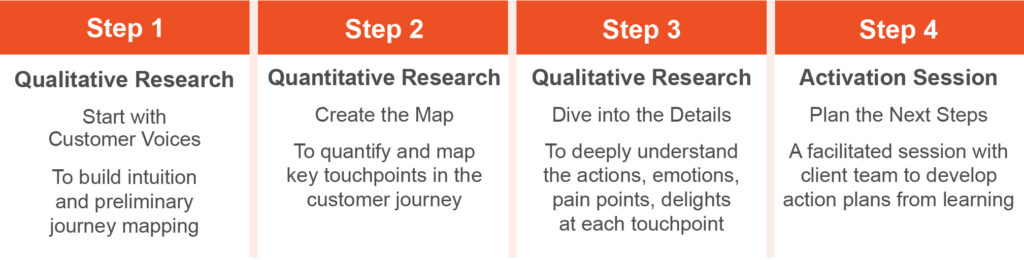
With preliminary insights that build team intuition, quantitative survey data to build and validate the journey, followed by qualitative deep dives to uncover the nuanced details, the true customer experience can be revealed. Teams can map customers’ interaction with the brand across each touchpoint, identify opportunity areas to act on and then track the customer experience annually, to ensure the quality of the experience remains positive or improves over time.
With the journey maps in hand, SIVO’s best practice is to facilitate an Activation Session so that client teams can immerse themselves in the journey and the voices of the customer. A few group discussions and exercises help teams to digest the learning, translate and prioritize into an action plan that can be shared with key stakeholders across the organization.
To discuss your customer experience research needs with experts from SIVO, please reach out to our team at Contact@SIVOInsights.com.
In today’s fast-paced world of AI-powered dashboards, real-time metrics, and instant feedback loops, businesses are flooded with data. But despite this access to information, many teams are still struggling to truly understand their consumers.
Why? Because understanding doesn’t come from data points alone. It comes from empathy – the ability to see the world through your consumers’ eyes.
Empathy is not just a soft skill. In a business context, empathy for your consumer is a strategic asset. And when used intentionally, it becomes a competitive differentiator that can unlock sharper decisions, faster innovation, and stronger brand resonance.
Empathy in a business context goes beyond surface understanding: It’s the process of cognitively and emotionally connecting with your consumers’ experiences, motivations, and needs.
Consumer empathy allows teams to:
And most importantly: it allows your team to move beyond assumptions and act with confidence.
What we see most notably, with the rise of AI, more and more executive teams are pushing for faster, leaner decision-making. But without a connection to real-world consumer behavior, speed risks becoming shallow, and very costly. From an insights perspective, developing empathy within organizations and training teams isn’t a nice-to-have or a luxury – it’s a necessity.
And these are just some examples. Empathy fuels smarter decisions at every level of the business, in all departments.
Whether you’re a CMO rethinking brand positioning or an Insights Director building your learning plans, here are some key tools to bring empathy into strategy:
Spending time in your consumers’ real environments (their homes, their workplace, neighborhood stores, their daily routines, even in their cars) allows you to uncover insights that would never surface in a focus group or controlled environment. Watch for routines, artifacts, interactions, and decision-making moments. What feels normal to them might be revealing for your team.
Ethnographic interviews are perfect to use when exploring new segments, refining product strategy, or understanding how a category fits into everyday life.
Understanding how people actually make choices at shelf (or online) tells you more than any survey can. What stops them? What persuades them? How do they navigate the retail space? How does your product show up relative to your competitors? Shop-Alongs and Path to Purchase Observations are perfect when optimizing in-store experience, packaging, or online conversion strategy.
These immersive, multi-day learning experiences are designed to help teams step into the shoes of their consumers – literally. Whether it’s joining farmers on their land or shadowing a parent on a morning routine, empathy treks bring brand teams (and senior leaders) closer to the emotional context that drives decisions. It’s a common tool to aligning cross-functional teams, inspiring innovation, or uncovering core brand truths.
Mobile mission software, accessed through smart phones, gives you visibility into your consumers’ world in real time or over time. From what they eat and wear to how they talk about brands, these tools capture lived experiences in context, without disrupting them. Digital diaries are perfect for when businesses are looking to understand rituals, routines, and the evolving emotional process of the consumer journey.
Empathy doesn’t end with the research. In fact, it’s only the beginning, and companies should strive to embed it in their day-to-day businesses. But how? That’s where tools like Insight Activation Sessions come in, to help teams translate empathy into action by reframing findings as strategic questions, idea starters, or business moves. A perfect move to embedding insights into planning cycles or cross-functional decision-making, for long-term results.
At SIVO, we love helping clients across industries uncover powerful insights through empathy-driven methods. Here are just a few examples of past cases:
A leading electronics retailer struggled to connect with their consumers – their messaging felt clinical and cold. By stepping into the real lives of their target market, in their own homes, we uncovered the emotional language that truly resonated. The result? Clear direction on positioning and communication strategies – and a renewed path to success in a challenging category.
A global beverage brand was losing relevance across key consumption occasions. Through immersive virtual ethnography, we helped them see how emotions, rituals, and motivations shaped beverage choice across six countries. This empathy-powered understanding led to sharper messaging and inspired marketing activation across core segments.
An electronics brand expanding globally needed to understand what truly drives consumer decisions – but sales data alone weren’t cutting it. Through ethnographic interviews and in-store observations across multiple countries, we uncovered key journey moments that shaped how and why people buy. The insights directly informed their brand growth strategy.
A recreational vehicle company wanted to identify new opportunities for innovation and product improvement efforts – but needed to understand the deeper feelings associated with their utility vehicles. The SIVO and client team spent quality time with farmers and hunters on their properties, riding in their vehicles to see and feel how these vehicles integrated into their consumers’ lives, their farming businesses, and leisure time.
Empathy isn't just a buzzword or about "feeling good" – it's about making better decisions, for you, your company, and your consumers. When you understand the world your consumers live in, you can make decisions with more clarity, alignment, and confidence.
Ready to move from unaware to empathetic?
Let’s explore how empathy can drive better decisions across your company!
by Julie Rose
I’ve been in the workforce for over 30 years (GASP!). I’ve witnessed and been part of a lot of change. Changing technology is a mainstay in the Age of Information, which is centered on accessing information and knowledge easily and quickly. Artificial Intelligence (AI) and machine learning is another advancement in getting that knowledge even faster and more quickly.
With each advancement or new tool, there is the inevitable talk of our jobs going away because the latest advancement is expected to replace us. In many cases, with advancement in technology, there are shifts that do render obsolescence. From my experience, it is the past technologies, not people, that have become obsolete. As people, we adjust, we leverage, we apply critical thinking, we learn, and take advantage of technological advancements to be more effective and efficient but we typically are not replaced.
Experience with Workplace Technological Advances
Early in my career, I was on the Email Task Force when email was just being introduced in the workplace. We grappled with tough topics, like were we going to allow employees to send personal emails. Yes, this is a true story! Email technology has made information flow much faster and easier. In fact, I don’t remember the last time I faxed something to someone. Email improved the way I work, but it didn’t replace me or make my job obsolete.
I also remember leading a team that was evaluating social media listening techniques and tools as we were trying to glean insights from the vast number of online conversations and content. People wondered if we would ever need to conduct primary market research again. People wondered if they would be replaced with Do-It-Yourself Digital scraping tools. It didn’t happen. I’m still here providing custom insights by leveraging the best market research tools to meet my clients’ business objectives.

The Soup-Starter, Not the Soup
The latest advancements in Artificial Intelligence have impacted every industry, and we are all evaluating it to figure out how to safely leverage it and integrate it into our current best practices. My reflection on the many changes I’ve personally experienced has helped me to formulate my thoughts on it. I’ve been asked quite a lot recently by friends, colleagues, and clients what do I think about AI, machine learning, and specifically natural language AI like ChatGPT or Google’s BERT. My latest answer . . . It’s the Soup-Starter, but it’s not the Soup (or the Chef!).
New tools like, ChatGPT, are an excellent way to access information and knowledge quickly and to easily get started on a topic or approach. It starts the soup, but it doesn’t finish the meal. Just like soup needs a chef, research needs a researcher, and insights require an Insights Professional. It takes discernment, creativity, experience, and nuanced choices to make a delicious, complex, flavorful pot of soup and the same goes for a custom market research study. Just like the chef might consider certain stocks and spices to start the soup, a researcher can start with ChatGPT to contemplate potential objectives, methodologies or questions before designing a custom market research project that fully meets the needs of the business.
Using ChatGPT in Market Research
When it comes to market research, we at SIVO have found ChatGPT and other AI tools to be a useful starting point in the following ways:
Evolve toward the Future
As AI technology evolves, we will evolve with it. We will leverage it to improve how we operate. For now, it becomes our new “soup starter” but we still own the recipe and must make the soup. All of us need to experiment and decide how AI can improve our ways of working but we will continue to apply our craftsmanship, critical thinking, and intuition to finish the job.
At SIVO, we are dedicated to understanding your business challenges and questions and will then use our expertise, resources, and access to technology to recommend a learning plan and approach that considers all variables and delivers on your needs. Contact us at Contact@SIVOInsights.com or go to SIVOInsights.com today to schedule a discovery call and connect!
SIVO Insights brings together research, talent, and intelligent technology to help organizations navigate complexity with confidence. Have a business challenge? Let's talk!
We bring together research, talent, and intelligent technology to help organizations navigate complexity with confidence