
Be consumer first. Don’t be consumer only. Powerful words by leading Insights executive, Khary Campbell, VP of Consumer Research & Insights at Comcast.
https://youtu.be/xJSQO7VSw5Q
During a recent SIVO Insights Forum, Khary shared the importance of considering the implications of all functions. After all, every function is working in orchestra of the business.
Click here for a lively on-demand conversation “Bridging The Gap: Translating Insights Into Meaningful Business Results" to hear from Khary and other Insights experts including Eliana Whanon (General Mills, VP of Consumer & Market Insights) and Elizabeth Oates (Book Author, and former Ulta Beauty VP of Consumer Insights.)
Learn from Insights leaders as they discuss:
Thank you to Natasha Weith, VP of Research at SIVO Inc. for hosting The SIVO Insights Forum!
by Kerry Juhl and Julie Rose
SIVO’s Organizational Intelligence (OI) solution offers leader development and coaching to our clients. Our OI team has many years of experience with one-on-one coaching engagements and group development sessions. We are also skilled at identifying employee insights, both through quantitative engagement surveys and in-depth employee discussions. As we have looked at leadership from both perspectives, we see 5 leadership traits that employees are looking for.

The Authentic Communicator
This trait is displayed in a leader who communicates well in one-on-one situations because they:
• Listen to understand - communication is a two-way dialogue
• Are empathetic - can put themselves in their employees’ shoes
• Share truth responsibly – even hard truths are delivered in a courageous and respectful way
• Are direct – messages are clear and concise to maximize understanding
This is also true for group communication because the communication is transparent, honest, and the leader can read the audience. Authentic communication can be delivered in multiple ways – written, verbal, in video, newsletters, etc.

The Learner Mindset
Everyone will make a mistake or fall short of a goal and when a leader reframes to a learner mindset from a failure mindset, employees gain confidence to take some risks, learn and grow. A leader with this trait might also choose to share a personal experience of failure and how there is growth from making mistakes. Through this humble approach, the leader is helping the team develop grit – that combination of taking measured risks, perseverance and resilience.

The Big Picture Thinker
Leaders who keep a greater purpose in mind, for themselves as well as for the company, and cultivate a sense of purpose on their team tend to have a more positive culture and better results. Employees need to understand how their work fits into the “bigger picture” so that all are making decisions with the same end goals in mind. Vision and purpose also give employees a sense that the work they do matters and that is critical in cultivating their engagement and enthusiasm.

The Reflector
Some of us have worked for a manager that is scattered and acts like everything is a fire drill. It’s exhausting! However, leaders that take even a quick pause to reflect on a project, on a day, or even a fiscal quarter are better equipped to provide thoughtful feedback and then tackle the next challenge. Gathering the necessary data, consulting with key stakeholders and team members before rushing off to the next thing can demonstrate a willingness to grow and learn from the past. It can also instill confidence in the team, knowing that all angles have been considered before taking the next step. Leading a team through an exercise of assessing what went well and what did not go well, and considering the potential for future obstacles can also be a particularly effective way to advance the team forward.

The Goal Setter
Leaders who continually set short-term and mid-term goals toward achieving the longer vision are much more effective leaders. Employees are seeking clear direction from their leader and while having a long-term vision is inspiring, without short-term goals, teams often find themselves churning with indecision, not knowing what their immediate next step should be. A great leadership tool is the SMART goal setting framework. Goals should be Specific, Measurable, Actionable, Realistic and Time-oriented. Having SMART goals also makes it possible to pause and celebrate when the team achieves the goals as it happens!
Do you possess these 5 traits? As it turns out, all leaders are working to achieve excellence in leadership and in business impact. Shoring up your skills and taking action to develop these 5 traits will make you a more effective leader on both fronts.
To talk more about leadership development, leader coaching engagements, or employee insights, please contact the SIVO Organizational Intelligence team at LeaderInsights@SIVOInsights.com
Through the SIVO, Inc. "Modern Ways of Working" Mini Chat series, we spoke with a strategic consumer insights leader, Anna Estlund, Senior Director of Insights and Strategy at Pernod Ricard.
In this conversation with Natasha Weith, Anna discusses how she is working to the ways her team works to drive impact and efficiency. Examples include building more flexibility into her teams roles, spending more time focused on the front and end stages of projects and hiring on demand talent to extend the bandwidth of her team. All of these things allow Anna and her team to maximize their value and relevance to the organization. Check it out!
https://www.youtube.com/watch?v=yhrIyqHooiM
Special thanks to Anna for generously sharing her experience and knowledge with our peers across the Insights industry!
By Kerry Juhl
The Responsibility & Privilege of Serving Customers
“A customer is the most important visitor on our premises. He is not dependent on us. We are dependent on him. He is not an interruption of our work. He is the purpose of it. He is not an outsider to our business. He is part of it. We are not doing him a favor by serving him. He is doing us a favor by giving us the opportunity to do so.”
– Mahatma Gandhi, 1890
This quote is more than 100-years old, but it is still true today. The opportunity to serve customers is a privilege. The responsibility of that privilege is ensuring the customer’s voice is heard and understood. Brand teams need to know what their customers need and what they value, as decisions about products and services are made on the customers’ behalf.
Defining Customer Value
Understanding customer value can be a differentiator for companies in today’s challenging market. Simplistically, if a brand team has $1 to invest – or needs to cut $1 in spending – knowledge about what customers’ value must guide these business decisions to stay competitive.
So let’s talk about customer value…In everyday conversations, value has many meanings including price, worth, or even benefits. It is imperative for organizations to operate with a common understanding of customer value. From a marketing and branding perspective, it helps to think about customer value as an equation:
Customer Value equals Benefits minus Cost (CV=B-C).

Benefits include the advantages of quality, service, image, brand, experience, and the functionality one gets or emotions one feels when using the product or service. Cost is not only price – which we think of as cash, credit, interest, even service fees - but it can also include non-price terms such as time, effort, energy, and convenience.*
When teams define their Customer Value Equation, they can clearly identify growth opportunities by emphasizing or improving aspects of an offering that customers value (where to invest) and they can identify cost savings by eliminating aspects of the offering that customers do not value (where to cut).
Developing the Customer Value Equation
SIVO employs a 5-Step Process to develop your Customer Value Equation. In partnership with our client teams, we Mine, Explore and Quantify the customer value drivers leveraging Functional, Emotional, Life-Changing and Social Impact values. Note that the Quantify Step can be qualitative consumer learning, a quantitative survey or ideally, a combination of both. The design of this step is dependent on how much past learning that the team already has in hand.
Four Categories of Customer Value

We then partner with teams to Develop & Refine the Customer Value Equation. Lastly, we help teams Apply their equation by assessing where their products/services are over/under-delivering and facilitate them through the generation of ideas to improve the customer experience.
The result of our process is rich with discoveries. These insights provide a unifying understanding of the target customers’ purchase drivers, must-haves and nice-to-haves regarding a product or service – giving teams confidence and clarity on what to do with $1 more or $1 less.
Our Offer to You
SIVO is interested in sharing our Customer Value Equation experience and case studies with you and your insights team! Our “CVE Download” can easily be part of an in-person or virtual “Lunch & Learn” or your next team meeting.
If you can answer “yes” to at least one of the following three questions, please reach out to SIVO.
To learn more, contact us at Contact@SIVOInsights.com.
*Referenced article by Gautam Mahajan https://journals.sagepub.com/doi/full/10.1177/2394964320903557
By Kerry Juhl
Our job as Insights Professionals is to not only identify relevant and unique consumer insights but also to apply the information in a way that influences decisions and drives action, resulting in growth. But ensuring that valuable insights are heard, internalized, and acted upon can be a challenge. Personal opinions, competing priorities or lack of focus can muffle the voice of the consumer, and the insights professionals that are trying to share it.
So how do you ensure that the insights you uncover will land with impact and be an enabler for growth?
SIVO has an answer… Growth Frameworks. Along with great storytelling, visually interesting media, and activation workshops, SIVO employs Growth Frameworks to organize insights into an inspiring construct, offering teams easily digestible, business-relevant content and common language for client teams to rally around, so they can clearly see and prioritize a path to growth.
What is a Growth Framework?
A growth framework starts with a deep examination of consumers within a market or occasion, to identify relevant insights. Those insights are then organized into a framework that reveals all possible avenues or opportunities for growth. The opportunities within the framework offer a “where to play” roadmap for teams, allowing them to prioritize opportunities and define their strategy for growth.
Examples of Growth Frameworks
Consumer Jobs/Demand Space Map – Consumer Jobs Maps (a.k.a. Demand Space Maps) help explain why consumers make the choices they make. Consumers use products that help them achieve their goals and meet their needs. In other words, products do “jobs” for consumers. If your product does not effectively do the job, consumers are unlikely to hire it. A Jobs Map becomes a framework to help identify ‘where to play’ and it lives beyond a single initiative. It maps all the jobs that consumers have for a particular occasion. For example, a Snacking Jobs to be Done (JTBD) Map includes all the jobs that consumers have for the snacking occasion. A Financial Investment JTBD Map includes all the jobs that customers have for investing their money. It lives on in your organization as a place to continually go back to for inspiration and focus for innovation, renovation, communication, and brand building efforts.

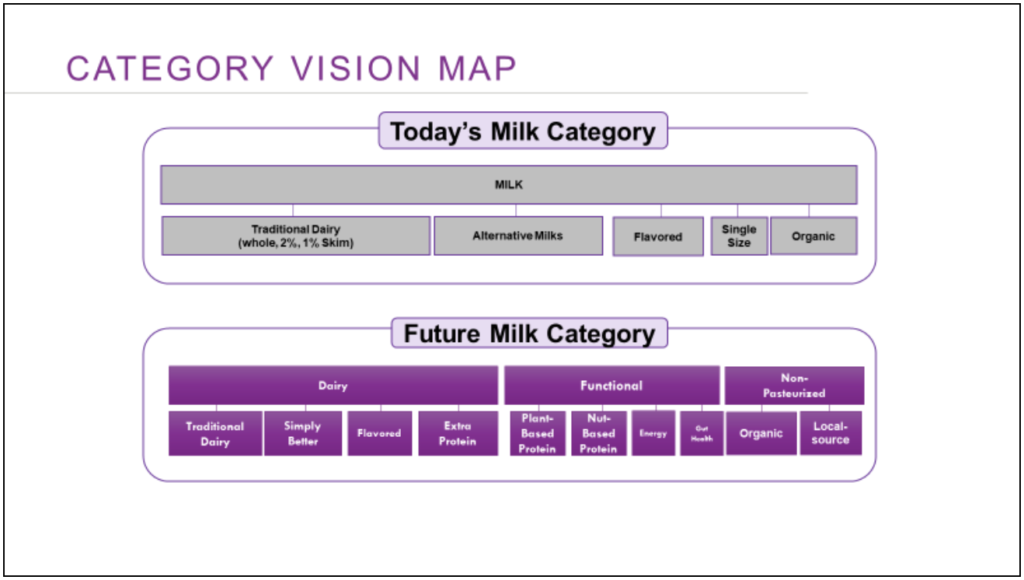
Category Vision Framework – A category vision framework envisions the category of the future. Although no one can predict the future, SIVO, in collaboration with the client team, develops a vision for what the future state of the category will be 3 to 5 years from now. This involves segmenting the existing and new products within a category based on the primary benefit that the products are providing to consumers. Specific attention is focused on new or emerging product lines within the category, and emerging consumer and market trends that may impact the category to identify “signals” for what the future category may look like.
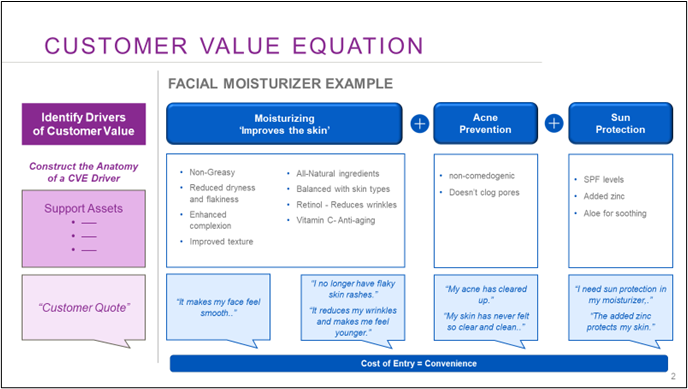
Customer Value Equation – A Customer Value Equation framework provides an understanding of what your customers value about your total brand experience by mapping the key drivers of value and the assets that support those drivers. This framework can guide team decisions on where to invest their next $1 to drive more consumer value or where to cut the next $1 in spending on product attributes that customers do not value. Knowing what drives customer value differentiates and enables companies to stay competitive.
Competitive SWOT – A SWOT (Strengths, Weaknesses, Opportunities, and Threats) framework is a strategic planning tool used by organizations to assess and analyze their current situation and help formulate future strategies. Oftentimes, a SWOT analysis is conducted in reaction to marketplace dynamics, or to proactively prepare for marketplace activities that could happen in the future. For instance, if a competitor acquires a third player in the category or conversely, goes out of business, organizations can develop a SWOT framework to better understand this new reality, and build strategies to respond in a future-focused way.

Benefits of a Growth Framework
Reach out to SIVO to learn more about Growth Frameworks
SIVO wants to help you and your organization elevate your insights into a growth framework that gives you consumer-centric focus, clarity of purpose and galvanizes your team to put you on the path to growth.
Reach out to the SIVO team at Contact@SIVOInsights.com to discuss the growth framework that will be the right strategic fit for your team and your business.
SIVO Insights brings together research, talent, and intelligent technology to help organizations navigate complexity with confidence. Have a business challenge? Let's talk!
We bring together research, talent, and intelligent technology to help organizations navigate complexity with confidence