
By Marilyn Weiss
In the evolving landscape of market research, methods that leverage technology are continually being developed to gain deeper insights into consumer behavior. Mobile Missions are a straightforward approach that has proven successful for SIVO clients. This approach allows researchers to tap into consumers' real-life experiences in a natural and engaging way, collecting meaningful data in the form of open-ended responses, photos and video footage.
Understanding Mobile Missions
Mobile Mission research is an immersive approach that leverages mobile technology to engage participants on their own schedule and in their natural environments. This involves prompting consumers to complete a series of activities and questions via their mobile devices, capturing their experiences, thoughts, and behaviors in real-time.
Benefits of Mobile Missions
Mobile Missions offer several advantages over traditional research techniques:
Real-Time Interaction: Participants receive prompts and tasks on their mobile devices, allowing them to respond in real-time as they shop, prepare, or use products.
Natural Environment: The method captures consumer behavior in real-life settings, such as their homes or local stores, ensuring more genuine participation and deeper insights.
Engagement and Comfort: Participants can complete tasks at their own pace, allowing them time to reflect and encouraging more thoughtful and honest responses.
Remote Observation: Researchers can observe and interact with participants remotely, making it easier to conduct research in environments where in-person observation might be challenging or restricted.
Applications for Mobile Missions
Mobile Missions are versatile and can be utilized to achieve various research objectives. Five common applications that we see at SIVO include:
1. Shopper Insights
2. Customer Journey Mapping
3. Brand and Promotion Engagement
4. Behavioral Insights
5. Competitive Analysis
By utilizing Mobile Missions across these diverse areas, companies can gain a holistic understanding of their consumers and their products, leading to more informed decisions and tailored strategies that resonate with their target audience.
Executional Details
The execution of Mobile Missions typically involves the following specifications:
Your Partner for Progressive Solutions and Actionable Insights
At SIVO, Inc., we are on a constant quest to identify innovative solutions that lead to meaningful insights for our clients. We have had great success in utilizing Mobile Mission technology to capture consumer perceptions and behaviors in a natural and engaging manner to achieve your learning objectives.
Contact us via our website form or email us at Contact@SIVOInsights.com to schedule a discovery call to discuss your business and market research needs.
The great resignation took a major toll on businesses across industries in the last few years. Businesses that prided themselves in workplace culture, flexibility, and benefits saw long-time employees step down from their roles. At the same time, more and more companies face transformative restructuring, like acquisitions and mergers. Following such major changes in the world at large and within organizations, the opinions and beliefs held by workers changed tremendously, and even the most forward-thinking businesses have suffered the consequences.
With that, many businesses are looking for a path toward improving performance and commitment in the workplace. How can they avoid employee attrition in the future? How can they improve their processes to boost efficiency and support employees? How can they redirect leadership to provide the support those employees need? At the end of the day, organizational intelligence gets data-driven insights to answer all these questions, and much more.
First thing’s first, what is organizational behavior? Organizational behavior is how individuals interact and behave in groups. It’s especially relevant when looking at the workplace. Forward-thinking businesses take their organizational behavior seriously, because it greatly impacts employee satisfaction and engagement, leadership performance, and overall workplace efficiency and effectiveness. If organizations do not understand their employee behavior, perceptions and opinions, they miss out on insights that could holistically improve their business. The best way to get those opinions, and translate them into a strategic action plan is to leverage organizational intelligence solutions.
Who should gather organizational behavior data? Your team is full of subject matter experts on your business and your industry, but when it comes to gathering information on organizational behavior, they may not be the right facilitators. Internal teams will have natural bias and may have subconscious results in mind, and could therefore not ask appropriate, unbiased questions. Plus, when it comes to listening to your employees, you want to get thoughts from a wide range of team members. That means allocating the task to an outside expert, to increase cooperation by maintaining employee confidentiality. Ultimately, this gives every employee the opportunity to provide their opinions, maintaining employee anonymity while removing all potential bias from the initiative.

So, what are the keys to improving performance and commitment in the workplace? Understanding what motivates your team members is key to educating and empowering leadership to create a path toward a better future for your company. Get a breakdown on employee insights, leadership development, and strategic planning facilitation below:
What are the honest opinions of your employees when it comes to your business culture and processes? When leadership asks them directly, they will likely get a much different answer than an unbiased facilitator. However, there are many ways to gather this information from your team. An organizational intelligence expert can identify a custom learning plan based on your business, and implement solutions designed to get the most valuable feedback from employees. According to the Harvard Business Review,
“High-OQ (organizational intelligence) leaders foster an understanding, or ethos, of “who we are.” When leaders move from managing individuals or small groups to leading entire organizations, they need to create a shared understanding of what’s important and what the organization stands for — in other words, an ethos.”
What kind of exercises result in the best employee insights? This varies depending on the organization, but typically it comes down to both qualitative and quantitative research. Some examples of qualitative research include one-on-one interviews, small group employee discussions, and stakeholder interviews. Meanwhile quantitative research looks more like customized online employee engagement surveys targeted to specific employee teams, departments, functions, and regions. Often, employee engagement surveys are administered with regular frequency, e.g., annually or bi-annually, to measure positive or negative changes in employee satisfaction and engagement over time.
Your industry is constantly changing, your business is growing, and workplace expectations are ever-evolving. Is your leadership adapting to accommodate? Modern businesses must create an expectation for agility in leadership to keep employees engaged and motivated. That means regular leadership training, coaching, and development. Organizational intelligence experts can handle the task and provide tailored, relevant coaching that meets the needs of your leaders. It begins with one-on-one introductory sessions, a 360 degree leadership assessment and follow-up analysis, development planning and coaching sessions with leaders at all levels of the organization - executives, high-potential leaders, and new managers. This results in more effective leadership and impactful business management that can exceed the expectations of their teams.
What solutions are involved in leadership development? First, there is leader coaching and education, which can include leadership assessments, feedback, and career planning directly with leaders. This can take place individually or in group/cohort sessions. There is also team effectiveness training, which helps teams define their purpose, processes, roles and responsibilities, as well as individual contributions. This is especially important for businesses facing restructuring, where new teams are being formed and leadership responsibilities are changing.

You have so many initiatives in the works – strategic planning can feel like one of those tasks that could easily get pushed down the line. However, strategic planning is the high-level exercise that impacts every other element of your organization. Outsourcing guarantees timely and effective execution, especially when you pick the right partner for the job. Market research firms like SIVO offer comprehensive workshops to ensure your team develops a sound strategic plan that will successfully lead the company into the future.
These facilitated workshops are especially beneficial to newer businesses or businesses facing large changes, like acquisitions, mergers or a challenging external environment. Knowing how to bring teams together, leveraging critical and inspirational inputs is no small task. That’s why it’s beneficial to have experienced strategic planning facilitators on your side, to plan and facilitate the workshop so that you leave the session with a clearly defined vision, mission, values, plans and ownership assignments. Sessions may also focus on other topics, such as communications planning, insight activation sessions, special-interest group planning, and even competitive SWOT analysis. Regardless of the focus, each strategic planning session will help leaders develop and align on clear strategies for the future, to drive business success.
No matter the business, every employee wants to be heard. Creating a place for employees to provide their thoughts can only benefit your business. From an employee perspective, these people-focused exercises prove that leadership cares about their opinions and wants to make steps to improve their workplace experience. The same goes for dedicated strategic planning exercises and leadership development. These initiatives create a stronger, people-first organization positioned to succeed. When leaders are effective, employees are motivated, and business strategy is in place, it all adds up to improved performance and commitment in the workplace – and more success in the market.
Organizational intelligence services result in game-changing insights that can transform your business for the better – and position you for even more growth down the line. Your team members have the deep knowledge about the company and industry, and often, their perspectives can unlock opportunities that leadership would have never otherwise considered. Once those insights are relayed to leaders with actionable recommendations, you can accomplish so much more within your organization.
Are you ready to gain insights on your organizational behavior? Get information on every aspect of your organizational behavior with SIVO. Our team of organizational intelligence experts can help you lead your team through any major transition. We work with organizations across industries, and build custom insight solutions that holistically improve performance and commitment in the workplace.
Contact SIVO today to discuss your business needs and get support.
By Cindy Blackstock, CEO and Founder
Customer experience—say it and everyone’s ears perk up. CX is influencing and intersecting with consumer insights across most business sectors: CPG, Retail, Automotive, Financial and Healthcare, to name a few.
The X Factor
Despite it being a buzz worthy term, there doesn’t seem to be a singular, agreed-upon, industry-wide definition for the term customer experience, affectionately referred to as CX. Definitions and approaches to CX vary but most just want to know what that “X” factor means for categories, brand, and products.
Here at SIVO, we have our own perspective:
In truth, we have been working to reveal the customer experience all along. For us, it’s not an intimidating or nebulous concept, because we are quantitative and qualitative research experts who are skilled at understanding people to reveal their truths. Through the optimal combination of quantitative and qualitative research approaches, we get to the “what” by collecting customer experience data, identifying the touchpoints along the customer journey. Then, we get to the “why” behind the customer experience data—the stories, emotions, pain points and delights—and translate it into actionable ideas that businesses can use. The two research approaches go hand in hand with the discipline of CX.
Data + Stories = A Winning Formula
Many market research vendors try to capture the customer experience primarily through quantitative research techniques. Survey data is essential for quantifying the various paths and touchpoints along the customer journey. It plays an important role in validating the experience, so teams can also measure change over time. But the process can’t stop there. Survey data is necessary but is not a comprehensive measure of the customer’s voice.
SIVO believes clients need a better blend of data and stories to get the complete picture. It is the human component, in a truly “experiential” in-context setting, that brings the customer experience to life. To make a business impact, organizations need that qualitative, intimate understanding of the experience, to find out what is truly happening during each touch point. In other words, we believe that quantitative research helps identify what to improve, and qualitative research helps identify how to improve the customer experience.
The Steps to Insights
Your customers are on a journey. There may be many individual stops on the route that make up the overall experience. For example, access may be acceptable, customer service may be satisfying, but there may be positive and negative aspects of the product experience for the user. All these individual touchpoints may net to an acceptable customer experience but may not reveal the nuanced opportunity areas that could lead to an improved experience. Brand teams need to talk to customers and ask, “How are you doing?” instead of, “How are we (the company) doing?” These questions reveal the crucial and detailed human element of CX.
SIVO stiches together a map, an outline of the touchpoints that make up the journey of the entire customer experience. SIVO’s typical approach is 4 Steps:
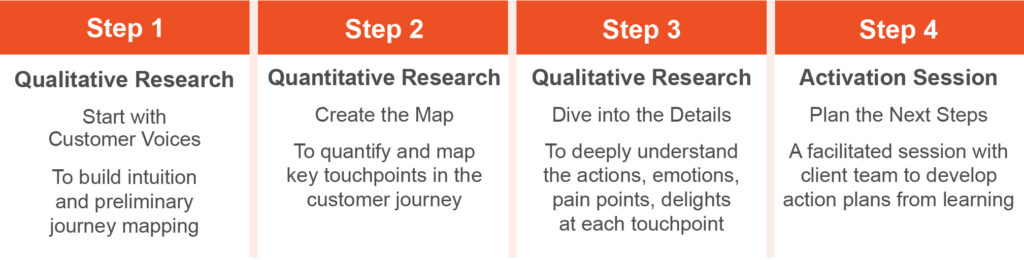
With preliminary insights that build team intuition, quantitative survey data to build and validate the journey, followed by qualitative deep dives to uncover the nuanced details, the true customer experience can be revealed. Teams can map customers’ interaction with the brand across each touchpoint, identify opportunity areas to act on and then track the customer experience annually, to ensure the quality of the experience remains positive or improves over time.
With the journey maps in hand, SIVO’s best practice is to facilitate an Activation Session so that client teams can immerse themselves in the journey and the voices of the customer. A few group discussions and exercises help teams to digest the learning, translate and prioritize into an action plan that can be shared with key stakeholders across the organization.
To discuss your customer experience research needs with experts from SIVO, please reach out to our team at Contact@SIVOInsights.com.
Some teams see the end of the fiscal as a time to take a break, get across the finish line, report on what happened, and then roll into Q1. The problem with this is that they will start next year with the same blind spots they currently have.
Others use this window to listen more deeply, sharpen their focus, and make a few targeted moves that change the trajectory of the next 12 months. (And by the way, this work doesn’t start in Q4, in starts right now, in Q3, when there is still time to learn and make decisions for the future.)
If you want to be in the second group, here are five practical activities to prioritize now, plus how SIVO can support you with both market research solutions and fractional insights professionals along the way.
Before you finalize next year’s plans, you need clear, current truth from the people closest to your business:
Structured “truth mining” conversations cut through assumptions. They reveal:
When you bring these insights into Q4 decisions and planning, you stop guessing. You can prioritize initiatives, messaging, and investments that are anchored in reality, not internal opinion.
SIVO Research team will step in as a neutral, expert listener to:
If you need internal team capacity as well as expertise, our fractional insights professionals can also embed within your team to design and manage this work.
Once you’ve listened to people, you need to look at the numbers.
A focused year-end review should answer two questions:
The output from this analysis should be a short, honest view of:
Going into Q4 and the new fiscal year with this clarity prevents you from repeating expensive experiments and keeps your team focused on what actually creates value.
SIVO will support this review by providing fractional Data Analytics Expert leadership. We can partner with your analytics and finance teams to connect research and performance data. Our Data Analysts can build a concise “year-in-review” insights deck that integrates insights and clear implications around category and channel performance, competitive actions, customer trends and promotional performance.
With fresh insight and performance context, the next step is to see your business the way your customer actually experiences it.
Mapping the customer journey means collecting qualitative and quantitative data and then documenting the key stages from first awareness through purchase, onboarding, usage, and loyalty/advocacy. This will capture what your customer is feeling, fearing and trying to accomplish at key decision moments. This work usually reveals two things:
Identifying and fixing the biggest leaks or friction points in Q4, can improve conversion and strengthen retention among your potential and existing customers in the coming year. It also gives the marketing, sales, product, and service teams a shared picture of “the customer journey we are trying to serve.”
SIVO’s customer experience and journey mapping will help you identify key stages, emotions, needs, pain points, and opportunity areas that will have the greatest impact on satisfaction, loyalty, and revenue. Our experts will facilitate activation workshops so your team can align on the journey and choose focus areas and plan for the coming year.
At this point, you’ve heard from your stakeholders and customers, reviewed the market and your performance, and seen the end-to-end experience. Now you can answer two critical questions with much more confidence:
This work becomes a filter for which opportunities to pursue and when to move on. It gives the team a consistent and differentiated story to tell, in website copy, sales decks and customer service conversations.
Depending on the existing customer data and knowledge that you have, SIVO will customize to your needs which may include, leveraging new and existing data to identify and map jobs-to-be-done, facilitate working sessions to build your ICP and test positioning statements.
Specifically:
The final step is to turn all this learning into focused action.
Rather than a long, generic annual plan, start with a 90-day, growth-aligned plan for Q1 that:
The key is to make Q1 a testbed for insight-led action, using all that you have learned in Q4 of this year.
SIVO will support this translation from insight to action through:
SIVO doesn’t stop at the delivery of insights and recommendations. Our team’s sweet spot is in being your strategic partner to help you get from insights to action plans so your team can align and execute with confidence.
The difference between a “normal” year and a breakout one rarely comes from a single big bet. It comes from a series of better-informed decisions, made consistently.
Q4 can be a pivotal time for your team, that sets you up for a successful next year. These 5 moves:
…give your organization a different kind of starting line for the coming year.
If you’d like help with any of these steps, whether that’s a focused research engagement (using survey or AI-powered intelligence tools) or a fractional insights leader to guide the work, SIVO can plug in at the level you need and at the pace your business can absorb.
SIVO Insights brings together research, talent, and intelligent technology to help organizations navigate complexity with confidence. Have a business challenge? Let's talk!
We bring together research, talent, and intelligent technology to help organizations navigate complexity with confidence