
By Julie Rose
“CEOs aren’t feeling the need to hoard labor as much as they once did. A quarterly survey of CEO confidence released on February 8, 2024, by The Conference Board, a think tank, shows 23% of CEOs expect to lay off workers in the next 12 months, up from 13% from the previous quarter.” *
With employee staffing constraints and cutbacks sweeping through many companies, business teams are feeling the pressure. So how does the work get done?
We know that business leaders continue to seek actionable insights to guide their decisions but there are fewer people and often not enough time to get it all done. Many insights teams are turning to fractional talent to fill staffing gaps. This provides the freedom to say “YES” to internal stakeholders, set strategies and take on new projects while not burning out the team or falling short on annual objectives.
As teams consider their staffing options, here are three easy steps for making the case for adding fractional resources.
Step 1 – Outline what issue you are solving.
Use information on hand to justify what the “current state” is costing you and the business.
Step 2 – Evaluate and select the right resource for your needs.
Workforce talent continues to evolve and there is no shortage of options, including interns, fractional talent, contract to hire, or permanent hire. Determining what’s best for you and your organization is key. When evaluating the right resource for your needs, there are a few key questions. Short vs. Long term? Trained vs. Untrained? Junior vs. Senior Level? Hours per week? Budget parameters?
Step 3 – Make the case to your internal stakeholders.
Finding the right talent with experience and selling the option internally might seem daunting. With the right solution, it is possible. Present your case to internal stakeholders by outlining the business need, presenting a tight range of staffing solutions, including the benefits of your recommended choice, and the associated cost and timing. You may also want to include the bios or resumes of the potential talent you are recommending.
If your evaluation in Step 2 supports contract or fractional talent as the optimal solution, below are a few additional resources from SIVO that can help.
Why Choose SIVO On Demand Talent for your Fractional Insights Talent Needs
SIVO On Demand Talent is here for you, with exceptional insights talent for fill-in roles or finite initiatives. You will experience the uniqueness of SIVO On Demand Talent through our Experience, Service and exceptional Talent!
Contact SIVO, Inc. at Contact@SIVOInsights.com to discuss how SIVO can help you make the case for fractional talent. Also, check out SIVO’s On Demand Talent Profiles to learn more about the many fractional Insights Professionals - from Insights Generalists to Research Specialists - that can be an asset to you and your team and help you meet your goals.
* Noted in a NerdWallet article, Will 2024 Be a Big Year for Layoffs? February 2024
In your brand's early development stages, you likely gave much thought to the idea of a buyer persona.
You researched who you expected to purchase your products, how they would interact with your brand, and which factors would influence them to choose your brand over a competitor's. You painted a picture of what their needs are, what they do, and how their key motivators would align with your offerings.
Now, it's time to see that journey in action.
The path to purchase describes the journey that your target buyers take from the moment they first discover your product or service until they ultimately decide to buy it. The better you understand this journey, the easier it is to connect with them at key milestones and decision points to convert them from awareness to consideration to purchase, and then to repeat purchases.
Today, we're sharing how to conduct this research effectively and what to do with the results you uncover.
Put simply, the path to purchase encompasses all of the steps that your users take as they convert from a prospect into a paying customer. This can include multiple different channels, touchpoints, and platforms.
While each person's brand experience will be nuanced and unique, most leads take a few central steps as they travel along this journey. These include:
Also known as a customer journey or buyer journey, the path to purchase can be a valuable part of your audience analysis. It allows you to climb inside the mind of your prospective buyers, and current buyers and understand why and how they're engaging with your brand.
Let's break these stages down a little, explaining the important aspects to research and analyze.
The first step in the path to purchase is awareness. This is the moment that your prospective customers first learn about your brand, and it sets the tone and the stage for the rest of your interactions together.
Years ago, mass marketing campaigns were more effective than they were today. Modern buyers want customization and personalization at every turn, and 80% are more likely to purchase from a brand that offers tailored experiences. This means that gone are the days when you could send out one e-mail blast or a generic postcard to your leads and expect them to convert.
Now, the most effective ways to reach your target audience include:
Not only should these outreach measures be personalized, but they should also include a call-to-action (CTA) that encourages users to take that next step. Do you want them to check out your website, sign up for your e-newsletter, contact you to set up a consultation? Remember to make the CTA clear, actionable, and easy to follow.
Once you've initiated the path to purchase, you can track your marketing efforts, e.g., engagement and response rate, to understand how effective your chosen tactics were. For instance, with inbound marketing campaigns, most website analytics platforms, such as Google Analytics, or CRM systems, such as, HubSpot, allow you to easily monitor the traffic going to your website, the number of views each blog gets, or the success rate of your paid online ads.
Regularly review these numbers to understand which channels are the most successful. Then, fine-tune the most profitable ones and look for ways to eliminate or phase out the ones that aren't as fruitful.
For larger brands with national distribution, you can also conduct advertising and brand awareness tracking research to understand the percentage of consumers who are aware of your advertising and brand, pre vs. post the execution of your marketing campaign or in regular intervals such as, one or two times per year.
Key questions to ask at this stage include:
Piquing the interest of your target buyer is only the first part of the path to purchase. Next, the prospect will consider all of the features that your company or product offers, comparing them against others in your same space. They're looking for differentiators that set your brand apart, such as price point, quality, speed of delivery, product features, and more.
To perform this competitive analysis, they may perform the following steps:
At the core of this step is the buyer's need for information and insights. If you can provide this intelligence about your solution better than anyone else can, then you're more likely to move them from this phase of the buyer journey to the next.
In this step, you'll need to research and manage your online presence and reputation. Do you know what your target buyers will see when they search for your brand name online?
There are reputation management tools that can help you uncover and respond to your company reviews. In addition to the reviews on your website or Google Business Profile, remember to also check common and industry-specific third-party review sites.
Another area to research is how well you've explained and demonstrated your product or service. If a prospective customer wanted to learn more about how your solution works, are there online descriptions, manuals, sheets, videos, or in-store signage that make this step simple? The more transparent you can be, the easier it is to compare your solution against another.
Key questions to ask at this stage include:
After a lead discovers and researches your brand, they may decide to take that next step and make a purchase. To help them get there, you'll need to provide information that reveals why your company or offering is the best fit for their needs.
Depending on the solution you offer, this could require the buyer to make a significant investment. They'll want to review all of their options and compare top features to make sure they're making a wise decision.
This final stage of the path to purchase is all about sealing the deal. Research your company's current methods for engaging prospects and moving them along the sales funnel.
Some companies with “Business to Business” (B2B) offerings might use this time to perform presentations, pitches, and demos to share how their products work. Others with “Business to Consumer” (B2C) offerings might use advertising, on-package claims, third-party endorsements and in-store signage to demonstrate their benefits to prospective buyers. . The nature of your business and the type of audience you serve will dictate the exact strategy you deploy.
Key questions to ask at this stage include:
At each stage of the consumer path to purchase, you'll have the opportunity to gather insights into buyer behaviors. As you do, it's important to know what metrics to track, when to dive in, and who to involve. Here are a few tips to help you make the most of the data you obtain.
As brands seek to improve their buyers’ path to purchase experience, most are focused primarily on hard numbers, aka quantitative data, about the purchase, including volume, amount and frequency of sales, who and where purchased, percent of repeat purchases, etc. While this type of behavioral data is extremely important -, but don't underestimate the value of qualitative insights about the buying journey.
The ultimate goal of each phase is to understand the mindset of your buyers, and you can't get there with quantitative measurements alone. You need to understand the emotions that your prospective buyers are feeling, as well as what's behind their concerns, hesitancies, and excitement.
A few of the ways you can capture qualitative feedback include:
Not only are these insights helpful in directing your current and future campaigns, but they can also motivate your internal stakeholders. If you can share direct quotes and client feedback with your C-suite and marketing teams, it's easier for them to understand the human side of their work, in addition to the technical and economical side.
For some B2C companies, there is a primary shopper involved in each brand interaction. However, most B2B transactions involve other, behind-the-scenes decision-makers and influencers.
As such, resist the temptation to consider the path to purchase as strictly linear and one-dimensional in nature. In reality, it's more multi-faceted and complex.
Try to learn about the key stakeholders involved in buying decisions, as well as their specific roles. It also helps to understand how they interact with one another, as well as when each one enters and leaves the buyer journey. While some will be involved from start to finish, others may join and leave at different times.
To get the fullest view of your path to purchase, don't start your research at the first time the buyer and seller interact. Instead, go back even further to the pre-shopping stage. Increasingly, this means analyzing how buyers live, work, and how they find and compare offerings to meet their needs.
Today, most buyers are hopping online to discover new brands. In fact, in the B2B sphere, the average customer performs 12 different searches before deciding to engage with a specific brand. While it can be difficult to pinpoint exactly when a buyer first discovers your brand, spend time exploring different purchasing triggers to understand how to optimize these interactions.
As you research and learn more about your customerpath to purchase, you can customize and fine-tune your offerings and marketing communications to appeal precisely to those who are interested in them the most.
At SIVO, we're dedicated to helping our clients understand their buyers' needs, beliefs, and behaviors. We can help you gain visibility and address challenges by asking the right questions directly to your target audiences. Then, we'll work with you to turn those insights into actionable steps that can drive conversions, improve engagement, and build brand reputation. Contact us at Contact@SIVOInsights.com or go to SIVOInsights.com today to schedule a discovery call and connect!
By Julie Rose
As someone who has spent over three decades in the market research industry, I've seen firsthand how technology reshapes our professional lives. The advent of online surveys, the rise of internet scraping and text analytics, opportunities coming from big data mining, and the now the integration of Artificial Intelligence (AI) all represent significant milestones in the Digital Age intersecting with the Market Research Industry.
AI isn't just a new tool; it's a game-changer. It's capable of automating repetitive tasks, processing and analyzing vast amounts of data, at speeds previously unimaginable. It is an exciting time to once again, adopt new ways of working that will advance our mission to understand people and deliver insights that drive business growth.
New Heights in Market Research Analysis
In today's fast-paced world, the volume of data generated daily is staggering. AI excels at sifting through this data, identifying patterns, and providing preliminary insights. This capability is invaluable in market research analytics, where the first step is often labor intensive to comb through a variety of data sources to identify patterns, anomalies, outliers, consistencies and inconsistencies.
Here are a few examples of where AI analyses can advance market research:
Practical Considerations
AI takes data processing and analysis to new levels, providing speed and pattern recognition that was unheard of even a few years ago. That said, the storytelling aspect of market research - translating data into a clear and inspiring story with actionable insights that will unlock new growth opportunities - is where human expertise shines.
Embracing the Future of AI in Market Research
As AI technology continues to evolve, so will SIVO’s approaches and techniques. We view AI as a powerful augmentation to our workflows and capabilities and will continue to experiment and adopt new ways of working that drive our effectiveness and efficiency. At the same time, we believe that it is the combination of the AI tools and experienced, empathetic market researchers that skillfully identify the nuances of consumers perceptions and behaviors that leads to actionable, strategic insights. We will continue to invest in both resources – artificial intelligence and human intelligence.
Join us on this exciting journey
At SIVO, we are committed to blending the best of human expertise and AI innovation to deliver insights that drive your business forward. Contact us at Contact@SIVOInsights.com or visit SIVOInsights.com to schedule a discovery call and explore how we can help you take your market research to new heights!
by Kerry Juhl
Consumer Personas are a great tool for bringing your consumer target to life for your organization, to inspire growth ideas, new brand experiences and product innovation. It is a representation of your target segment based on a combination of quantitative and qualitative data. It summarizes your consumers’ lifestyle, values, needs, challenges, and preferences, so that it can be easily shared and digested across the organization.
At a high level, here is SIVO’s guide on how to build consumer personas:
Building your Consumer Personas
Key information that should be considered when building consumer personas includes:
Check out these other SIVO blogs on consumer targets and consumer segmentation, to better understand the inputs and context for consumer personas.
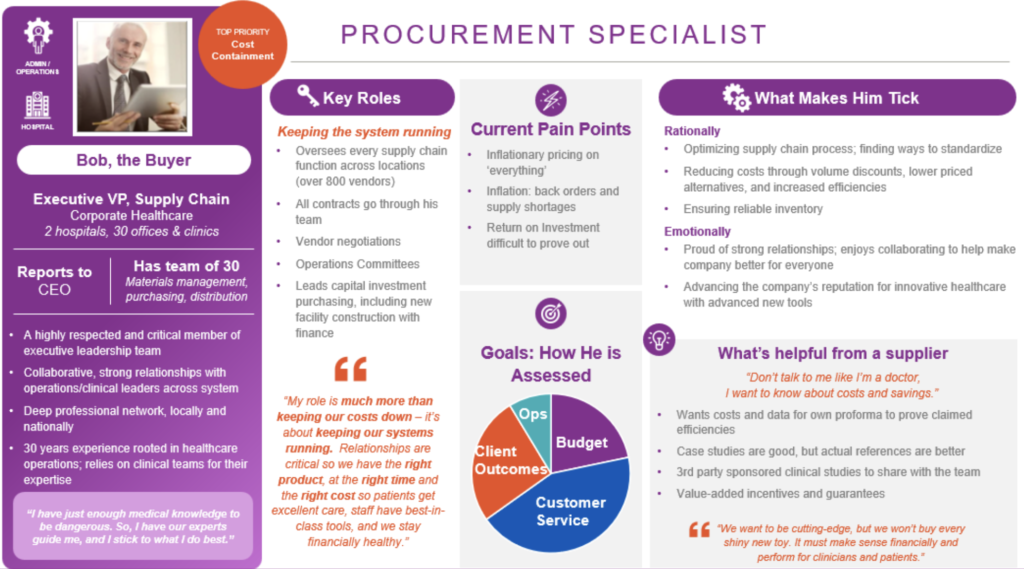
Making Consumer Personas Interesting
The goal is to bring the consumer to life in an interesting and inspirational way. This information needs to be interesting and easy to read so that it gets internalized by the organization. Here are a few tips:
Keep it Brief: A good persona should be 1 to 3 pages in length. Ideally, there would be a 1-page summary and if needed, 1 to 2 follow-up pages with actionable details and insights.
Use Visuals: A persona should be visually interesting. Use photos, graphics, or infographics to bring the consumer persona to life and make them feel more tangible and relatable to your team.
Use Narratives and Quotes: Storytelling is an important part of building your persona. Use the data to create a short 1-paragraph narrative that describes the consumer persona – who they are, what they need, and their underlying motivations.
Include a Key Consumer Insight: It is important to include a one-sentence insight that describes the underlying motivation that would make them potentially interested in buying your product or service.
With the data summarized and visualized into clear and succinct personas, it is easy to understand and empathize with your consumer target, i.e., the segment of consumers that will inspire your growth ideas, marketing communications, promotions, distribution plans and new product innovation. Your team can now tailor brand messaging, content, and product offerings to align with the needs and preferences of key consumer targets. It is also easy to socialize the learning across the organization and agency partners in an efficient and effective way.
Maintaining Relevance of Consumer Personas
Consumer personas are foundational marketing and insights deliverables that will inspire your teams’ growth ideas and guide your agency partners for years. For this reason, you need to invest in ongoing maintenance to ensure continued relevance to your organization. Depending on the volatility and competitive dynamics within your market, you will want to:
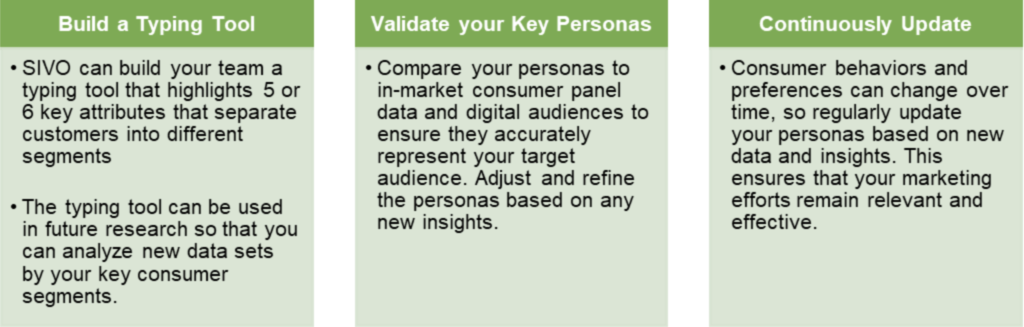
The success of your consumer persona profiles depends on the quality of your research, the depth of your understanding and getting it to land within your organization and with agency partners. Regularly leveraging the personas while also iterating and improving upon them will help you stay in tune with your consumers and maintain a competitive advantage in the market.
Your Source for Expert Customer Insights
At SIVO Inc., we are dedicated to helping our clients understand their consumer targets by designing and executing consumer segmentations, following up with qualitative research and building consumer personas. We can then facilitate activation sessions with your team to develop action plans and strategies that leverage these insights.
Reach out to us at Contact@SIVOInsights.com or go to SIVOInsights.com today to schedule a discovery call and connect!
By Marilyn Weiss
In the evolving landscape of market research, methods that leverage technology are continually being developed to gain deeper insights into consumer behavior. Mobile Missions are a straightforward approach that has proven successful for SIVO clients. This approach allows researchers to tap into consumers' real-life experiences in a natural and engaging way, collecting meaningful data in the form of open-ended responses, photos and video footage.
Understanding Mobile Missions
Mobile Mission research is an immersive approach that leverages mobile technology to engage participants on their own schedule and in their natural environments. This involves prompting consumers to complete a series of activities and questions via their mobile devices, capturing their experiences, thoughts, and behaviors in real-time.
Benefits of Mobile Missions
Mobile Missions offer several advantages over traditional research techniques:
Real-Time Interaction: Participants receive prompts and tasks on their mobile devices, allowing them to respond in real-time as they shop, prepare, or use products.
Natural Environment: The method captures consumer behavior in real-life settings, such as their homes or local stores, ensuring more genuine participation and deeper insights.
Engagement and Comfort: Participants can complete tasks at their own pace, allowing them time to reflect and encouraging more thoughtful and honest responses.
Remote Observation: Researchers can observe and interact with participants remotely, making it easier to conduct research in environments where in-person observation might be challenging or restricted.
Applications for Mobile Missions
Mobile Missions are versatile and can be utilized to achieve various research objectives. Five common applications that we see at SIVO include:
1. Shopper Insights
2. Customer Journey Mapping
3. Brand and Promotion Engagement
4. Behavioral Insights
5. Competitive Analysis
By utilizing Mobile Missions across these diverse areas, companies can gain a holistic understanding of their consumers and their products, leading to more informed decisions and tailored strategies that resonate with their target audience.
Executional Details
The execution of Mobile Missions typically involves the following specifications:
Your Partner for Progressive Solutions and Actionable Insights
At SIVO, Inc., we are on a constant quest to identify innovative solutions that lead to meaningful insights for our clients. We have had great success in utilizing Mobile Mission technology to capture consumer perceptions and behaviors in a natural and engaging manner to achieve your learning objectives.
Contact us via our website form or email us at Contact@SIVOInsights.com to schedule a discovery call to discuss your business and market research needs.
SIVO Insights brings together research, talent, and intelligent technology to help organizations navigate complexity with confidence. Have a business challenge? Let's talk!
We bring together research, talent, and intelligent technology to help organizations navigate complexity with confidence